RovingAudit may earn a sales commission at no extra cost to you when you purchase kits through our merchant links. How RovingAudit earns commissions
Needle felting transforms loose wool fibers into dense textiles and sculptures through repetitive agitation using specialized barbed needles. For a newcomer, purchasing individual supplies—graded steel needles, density-rated work mats, core wool, and dyed roving—can lead to mismatched tools and premature needle breakage. An all-in-one starter kit provides a balanced entry point by pairing the correct fiber quantities with suitable gauges and protective backing.
Before selecting a kit, you need to determine your intended creative format. Beginner kits divide cleanly into two distinct disciplines: 3D sculptural felting (building freeform animals, figures, and ornaments in the round) and 2D wool painting (layering fiber onto a fabric canvas or felt sheet held in an embroidery hoop). Below, we evaluate three practical starter kits covering both styles, alongside the technical anatomy of felting needles and wool selection.
Every functional starter bundle must include at least two needle sizes (a medium shaping needle and a fine finishing needle), a high-density protective foam or wool work surface, and unspun wool roving or batting. Project-specific kits should additionally include either structural armatures (for 3D) or printed backing sheets with hoops (for 2D).
Best Comprehensive Toolkit for 3D Sculpting and Freeform Crafting
If you prefer making miniature animals, decorative baubles, or experimenting without a rigid pre-printed template, a broad-palette multi-tool bundle is the most versatile starting point. Freeform sculpting requires an assortment of color accents alongside foundational hardware like multi-needle holders, leather finger guards, and mounting hardware.
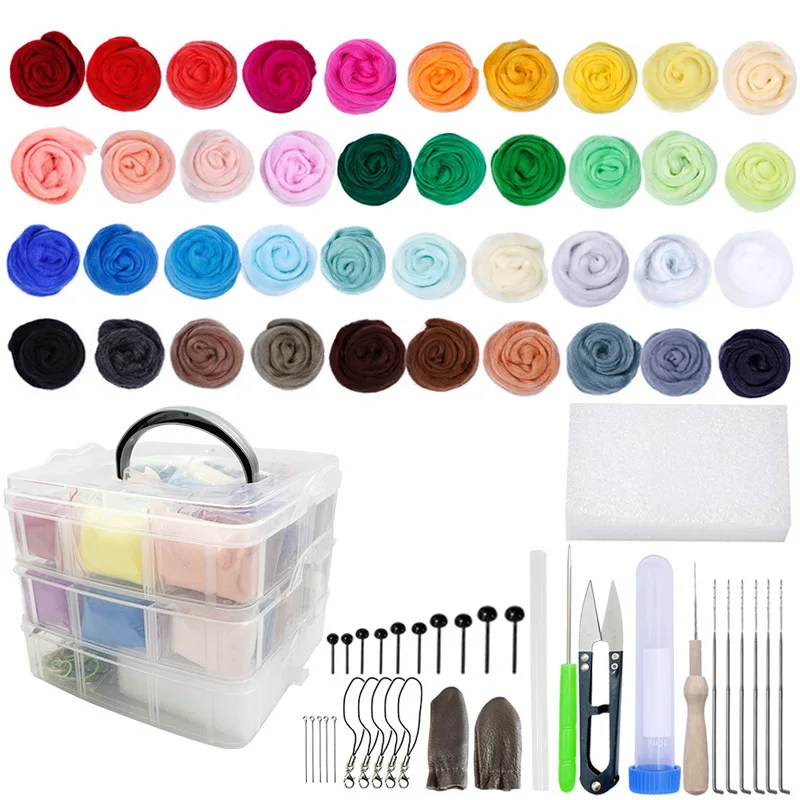
The 40-Color Needle Felting Kit with Tools provides a broad spectrum of pre-portioned dyed roving stored in a multi-tier organizer box. Its primary utility lies in the included accessory collection: leather finger cots, snips, an awl, safety eyes for small figurines, phone strap lanyards, and a wooden single-needle chuck handle. Working with unmounted barbed needles for extended periods quickly causes hand fatigue; a contoured wooden handle drastically improves grip mechanics and ergonomic control.
Practical limitations: Multi-color sampler packs contain small quantities (typically 3 to 5 grams) of each shade. While this variety is ideal for surface detailing, doll faces, and decorative accents, it is insufficient for building the interior mass of larger objects. Experienced crafters routinely build core shapes using inexpensive natural batting or coarser, un-dyed core wool, reserving vibrant roving exclusively for the exterior veneer.
Best Starter Kits for 2D Wool Painting and Framed Landscapes
Wool painting—sometimes called needle-felted embroidery—uses barbed needles to tack colored fibers into a stable woven or felt sheet base. Instead of sculpting three-dimensional forms in free space, you work within an embroidery hoop, treating wool like oil paint to blend gradients, skies, and textural foliage. Specialized landscape kits eliminate guesswork by supplying exact yarn/roving color palettes matched to a pre-printed backing.
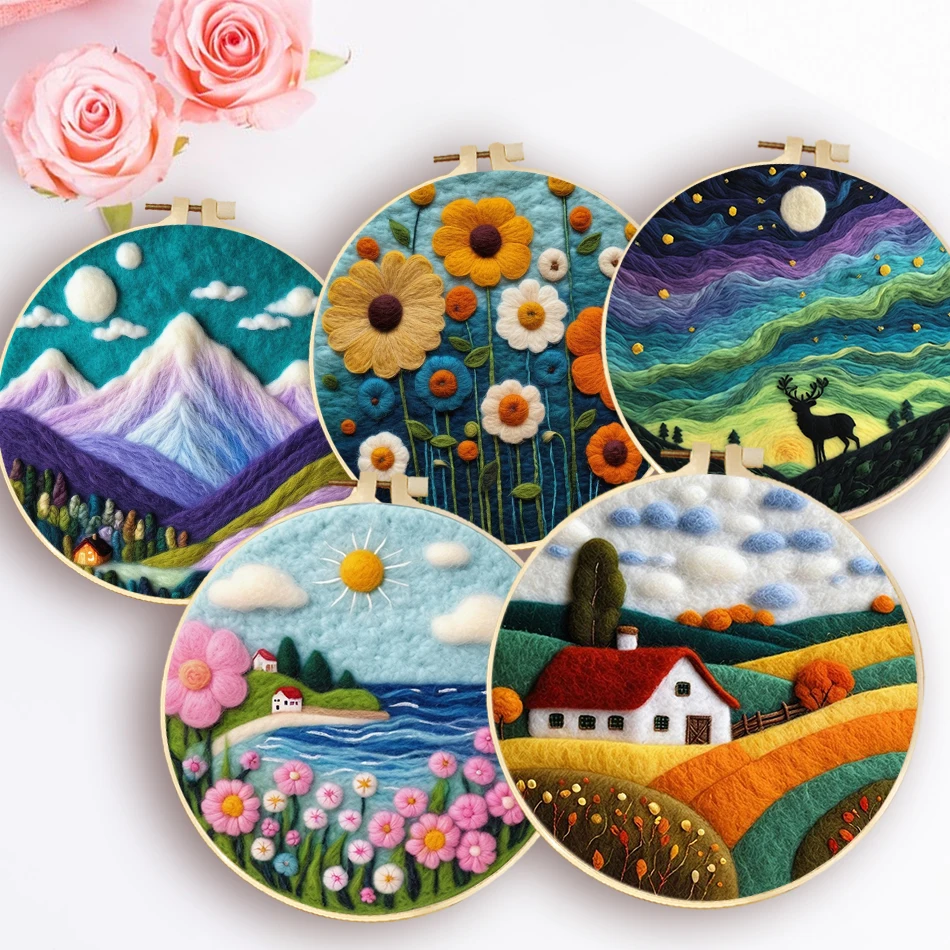
The GATYZTORY Landscape Wool Painting Kit focuses on pictorial wall art. These kits center on structured designs—such as mountain ranges, floral meadows, and cottage vistas—secured within a wooden or faux-wood display hoop. The provided wool is pre-sorted to match the design palette, allowing beginners to practice directional fiber laying, fine line rolling, and cloud texturing without needing prior drawing skills.

Similarly, the RUOPOTY Landscape Pattern Needle Felting Starter Kit provides a contained, project-in-a-box experience designed to yield a completed framed picture. Because 2D wool painting stabilizes fibers against a flat backing sheet—frequently framed on dense craft felt or linen as described by textile makers at LinPin Crafts—it is generally less prone to core structural collapse than freehand 3D modeling, making it especially forgiving for novices.
In 2D felting, needle depth should remain shallow (5–10 mm into the backing) to prevent the support fabric from puckering or pushing fiber straight through to the rear. In 3D sculptural felting, needles penetrate deeply into the center to compact internal fiber layers into a firm, rigid core.
Understanding Needle Gauges, Blade Profiles, and Mechanics
Needle felting needles are manufactured from hardened, high-carbon steel and feature sharp, directional barbs cut along their edges. When the needle enters the wool, the barbs catch individual fibers, pushing and intertwining them with adjacent strands. Unlike sewing needles, felting needles must never be bent or pried while embedded in the material; lateral leverage instantly snaps the brittle steel shaft.
| Gauge Size | Blade Profile | Primary Role | Best Used For |
|---|---|---|---|
| 36 Gauge (Coarse) | Triangular | Rapid fiber compaction | Initial bulk shaping, establishing cores, anchoring dense armatures |
| 38 Gauge (Medium) | Triangular / Star | All-purpose shaping | Attaching appendages, shaping contours, general 2D wool painting |
| 40 Gauge (Fine) | Triangular / Spiral | Surface refinement | Closing needle puncture holes, delicate facial features, whisker lines |
| Specialty (Reverse) | Inverted barbs | Extracting fibers outward | Creating fluffy animal pelts, fuzzy moss, or blending internal core colors outward |
According to tool specifications outlined by Woolbuddy's felting supply guides, 36 to 38-gauge triangular blades handle the majority of foundational work, while 40-gauge needles smooth out the pebble-like holes left by thicker tools. As noted by suppliers such as Crafty Jam, beginner sets frequently supply color-coded needle shanks or protective tubes to help users distinguish between fine, medium, and coarse tips without needing a micrometer.
Essential Work Surfaces and Safety Protocols
Because felting needles pass completely through the wool, working directly on tabletops or hard furniture will ruin needle points and scratch surfaces. Beginner kits mitigate this by including one of three primary work bases:
- Open-Cell Foam Blocks: Common in economy starter sets. Foam blocks cushion the needle tip safely and absorb over-penetration. Over time, recurring strikes compress the center of the block, and deteriorating foam can shed small bits of plastic into your wool project. They are suitable for entry-level use but should be replaced once deeply pitted.
- Dense Wool Felting Mats: Composed of tightly compressed 100% felted wool. They offer longer durability than open-cell foam and do not crumble, though loose fibers can occasionally stick to their surface if not peeled off periodically.
- Bristle Brush Mats: Raised polymer bristle pads hold 2D base sheets elevated, allowing needle tips to travel freely through the fiber grid without meeting solid resistance.
Safety Considerations: Due to sharp multi-barbed edges, felting needles must be operated with strict mechanical discipline. Always insert and withdraw the needle along the exact same angle. Tilting, twisting, or leveraging the needle against the mat will snap the tip inside the piece. Keep leather finger guards on your non-dominant thumb and forefinger at all times while holding small components close to the working area, and store needles inside rigid plastic tubes away from children and pets.
How to Select the Right Kit for Your Goals
To choose the right kit from the options above, evaluate your learning style and desired end result:
- Choose a Framed Landscape Kit (GATYZTORY #1 or RUOPOTY #3) if: You want a relaxing, guided craft session with a predictable decorative outcome. Wool painting kits are ideal if you enjoy embroidery, adult coloring, or paint-by-numbers, as they require no armature construction or 3D proportion balancing.
- Choose a 40-Color Tool Box (Kit #2) if: You want to build a long-term crafting supply station. If your goal is making needle-felted animal miniatures, brooches, or miniature food sculptures, having dedicated finger cots, safety eyes, a multi-needle chuck, and a wide color array offers significantly higher creative longevity.